Dermal Filler & Facial Balancing in Winchester, Virginia
Diagnosis before product. Support the right layer, restore proportion, and refine the face without chasing isolated features.
At Calibrae, facial balancing is not a syringe count or a preset formula. Danielle Wiley, PA-C evaluates facial proportions, bone and soft-tissue support, movement, skin quality, and the relationship between features before deciding whether dermal filler belongs in the plan.
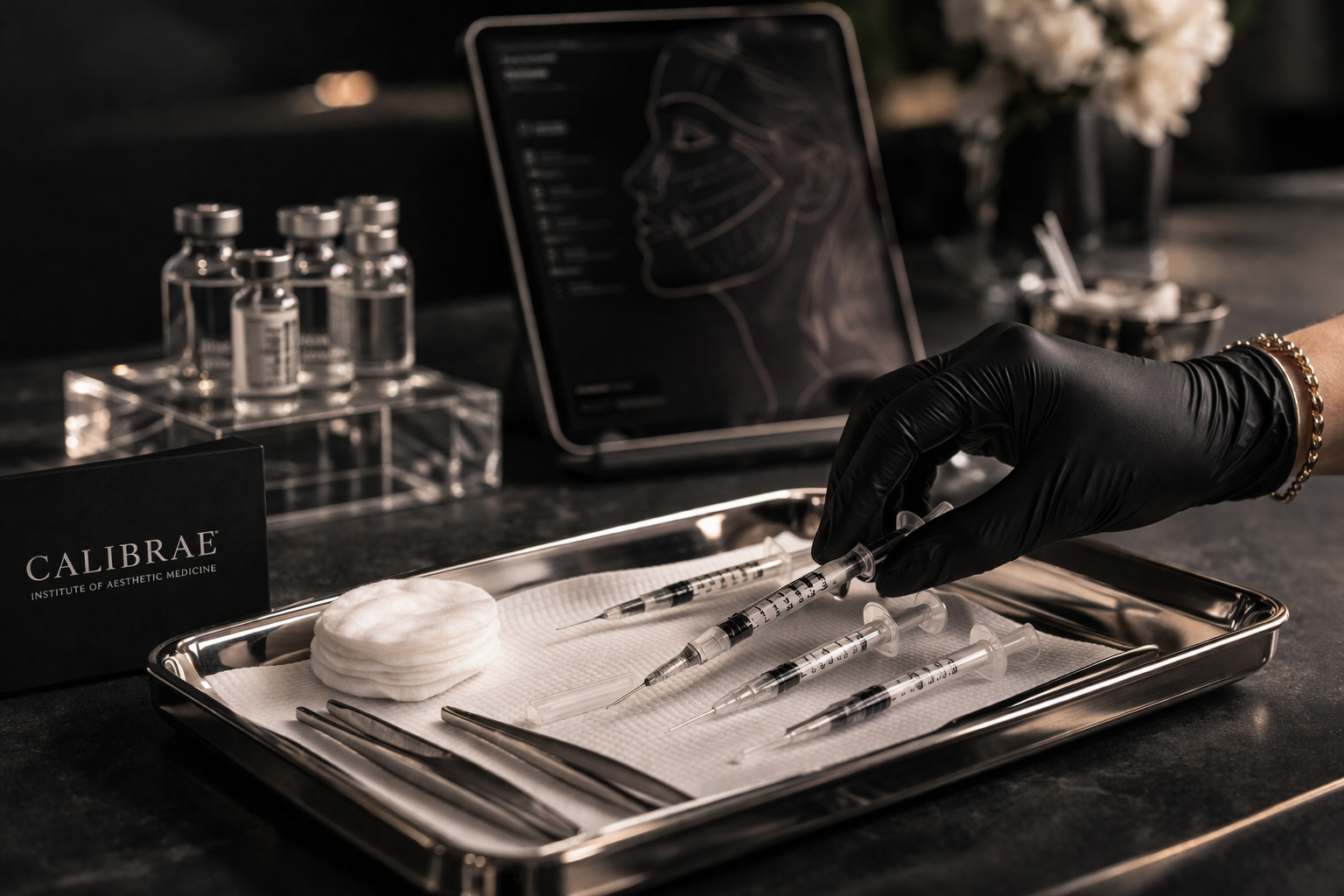
What facial balancing means at Calibrae
Facial balancing means looking at the face as one connected system rather than treating a single line, lip, or shadow in isolation. The goal is to identify where support has changed, where proportions feel disconnected, and which layer is actually creating the concern.
Sometimes that means adding subtle structural support. Sometimes it means leaving an area alone. Sometimes the better first step is a neuromodulator, Sculptra, microneedling, or skincare rather than filler.
How filler fits The Layer Method™
Dermal filler most often works within the structure and soft-tissue support layers. Depending on the product, anatomy, and treatment depth, hyaluronic acid filler can be used to support contours, restore selected areas of volume, refine transitions between features, and improve proportion.
The Layer Method asks a more important question than “where should we put filler?” It asks: what is driving what we see? Deep support, superficial soft tissue, movement, skin quality, and collagen loss can all create a similar visual complaint but require different treatment.
Areas that may be considered
Treatment areas and product selection are individualized. Some uses of dermal filler may be off-label and are discussed during consultation when clinically appropriate.
The RHA Collection at Calibrae
Calibrae uses hyaluronic acid fillers from the Teoxane RHA® Collection. Different RHA products are designed for different tissue depths, degrees of movement, and treatment goals. That allows product choice to follow anatomy instead of forcing one filler to do every job.
RHA 2 and RHA 3 are FDA approved for moderate to severe dynamic facial wrinkles and folds in adults age 22 and older. RHA 3 also has an FDA-approved indication for lip augmentation, and RHA Dynamic Volume is approved for cheek augmentation or correction of age-related midface contour deficiencies as well as selected dynamic facial wrinkles and folds.
Facial balancing is not the same as “more filler”
A balanced result can come from surprisingly small changes in the right places. Adding volume everywhere can actually make the face feel heavier or less proportionate. The goal is not to fill every hollow or erase every line.
Danielle evaluates superficial and deep support together, then uses the smallest treatment plan that meaningfully improves proportion. That may include treating the chin before the lips, supporting the midface before chasing a fold, or combining filler with another modality when more than one layer is involved.
Filler vs Sculptra
Hyaluronic acid filler and Sculptra are not interchangeable. Filler provides more immediate contour or structural support in selected areas. Sculptra is a biostimulator that works gradually by supporting collagen production and may be chosen when broader collagen loss, laxity, or diffuse structural change is the bigger driver.
Many patients benefit from one or the other, and some benefit from a staged combination. You can also learn how Sculptra fits The Layer Method.
Filler and neuromodulators do different jobs
Botox and Daxxify address the movement layer. Dermal filler addresses structure and soft-tissue support. If a line or shadow is caused primarily by repeated muscle pull, adding filler may not be the best first move. If the concern comes from proportion or support, toxin alone may not solve it.
That distinction is why Calibrae starts with diagnosis rather than product. Learn more about Botox or Daxxify when movement is part of the concern.
What treatment is like
Your appointment begins with an assessment of proportions, symmetry, movement, and the areas of support that influence the concern. Product choice, amount, and injection depth are selected based on the treatment goal. Because filler is a medical procedure, anatomy and safety come before aesthetic trends.
Temporary swelling, tenderness, redness, and bruising can occur. More serious complications are uncommon but can include vascular occlusion and, rarely, visual injury. Danielle reviews risks, alternatives, and aftercare as part of the informed-consent process.
Who may be a good candidate
Dermal filler may be appropriate for adults who want to improve facial proportion, restore selected areas of support, refine contour, or address volume-related changes. The best candidate is not defined by age alone. Anatomy, medical history, previous treatment, goals, tissue quality, and the specific concern all matter.
The Calibrae difference
Diagnosis before product. Treat the driver, not just the complaint.
That principle is the foundation of The Layer Method™. Instead of asking how many syringes a face “needs,” Danielle identifies the layer creating the concern, considers how each feature affects the next, and builds treatment in a sequence that supports the whole face.
Dermal Filler & Facial Balancing FAQ
What is facial balancing?
It is an assessment-based approach to improving overall proportion and support rather than treating isolated features by default.
Will facial balancing make me look overfilled?
The goal at Calibrae is refinement, not indiscriminate volume. Treatment is built around anatomy, proportion, and the smallest meaningful intervention.
What filler does Calibrae use?
Calibrae uses hyaluronic acid dermal fillers, including the Teoxane RHA Collection, selected according to the treatment area and tissue needs.
How many syringes will I need?
There is no universal number. The recommendation depends on anatomy, treatment goals, product selection, and whether filler is actually the correct modality.
How long does filler last?
Duration varies by product, location, metabolism, movement, and treatment amount. Your expected range is discussed during consultation.
Where is Calibrae located?
Calibrae Institute of Aesthetic Medicine is located at 3343 Valley Pike, Suite 400, Winchester, VA 22602.
Considering dermal filler or facial balancing in Winchester?
Start with the diagnosis, not the syringe. Danielle Wiley, PA-C will assess the layers creating the concern and determine whether filler belongs in your treatment plan.